
Feeling the heat from those new customers on how you can prove what you’re doing on social & environmental responsibility? Struggling with attracting and retaining talent?
The truth is, having an initiative here and there, without a clear red thread or third-party verification, is not always enough nowadays to win that big business or attract great talent.
One way to be more convincing is to have a single narrative about all your impact, in a structured way.
B Corp certification creates a single sustainability narrative
B Corp is a third-party certification to prove a business is socially & environmentally responsible. It is also a global movement whose aim is to change the system away from unfair capitalism to fairer capitalism, by encouraging businesses to think about the positive impact they can have on their People and the Planet by:
- treating their staff better, in terms of finances, health & wellness, career development etc
- reducing consumption of natural resources
- supporting their local communities and charities
- engaging their suppliers on social & environmental issues
- providing excellent customer service
The movement started with 3 men who ran a basketball clothing company in the US, AND1. When they went to sell it, they wanted a way to ensure that the great social & environmental values they’d embedded in the company would remain, even as they moved on.
So in 2006, they founded B Lab in the USA. The certification assesses all areas of the business and shows how you consider People and Planet are just as important as Profit. It doesn’t just evaluate a product or service; it assesses the overall positive impact of the company that stands behind it.
Stakeholder-focus results in better choices, better outcomes
B Corps think about how their business will benefit all their stakeholders, which results in better choices, better outcomes and systemic impact, rather than only focusing on shareholder profits.
Stakeholders include your workers, your customers, your local community, charities, suppliers as well as the environment.
A thriving community showing how business can be a Force for Good
The UK is the country with the most number of B Corps in the world – who could be potential clients or suppliers, with social and environmental values aligned to yours.
There are over 9600 certified B Corps globally and over 2500 in the UK. Some well-known names include: Patagonia, Finisterre, Tony’s Chocoloney’s, Innocent Smoothies, Ben and Jerry’s, Simply Business, Toms and Fairphone.
Attracting and engaging talent
More and more people want to work for a business that cares nowadays – especially since Covid. People are realising that life is too short to work for a business that doesn’t take care of its employees or think about the negative impacts it has on the community and environment.
In a recent survey, UK B Corp SMEs (compared to non-B Corp UK SMEs) have seen:
- their annual employee headcount grow by 9.6%, compared to 0.5% for UK non-BCorps
- 54% of B Corp SMEs expected employee numbers to grow, compared to 29% of all SMEs
- B Corp SMEs reported an average staff attrition rate of 10% in the past year, compared to 16-20% for the wider SME population
A holistic approach to environmental sustainability
There is no hiding in the impact assessment; the questions interrogate into the depths of every aspect of the business. If you pass the score threshold to become B Corp certified, you know the business takes social and environmental responsibility seriously.
The process of becoming certified encourages you to reduce over-consumption of natural resources, so you will inevitably see cost savings where you make environmental efficiencies.
In terms of environmental sustainability, compared with non-B Corps, B Corps are:
- 2.5x times more likely to have policies that require using a low carbon transportation option
- 2.4x more likely to have programmes to reduce their end of life waste
- 2x more likely to be Carbon Neutral
- 1.8x more likely to assess the environmental impact of their organisation’s business activities
- 1.7x more likely to implement some form of water conservation in the majority of their corporate offices or plant facilities
Resources involved
As with any certification process, there are resource requirements attached.
It’s worth highlighting that the standards are currently transitioning away from an 80 point flexible scoring system (able to apply on this system until 31 December 2025) to minimum mandatory requirements with no scoring (available from January 2026). This is the biggest transformation of the B Corp standards since they started and it’s so that they remain up to date with the current world context.
The overall process on the new standards (v7) to become B Corp certified includes:
- Meet the minimum mandatory requirements. You now have about 30-35 minimum mandatory requirements depending on your sector & size, over the 7 topic areas. It can take anywhere between 9 to 12 months of improvements to comply with these minimum mandatory requirements. This is the part of the journey where you often go through the biggest transformation to becoming a truly responsible business.
- Meeting the legal requirement. B Corps make this legal change by updating their Articles of Association which prioritise all stakeholders of the business, not just shareholders.
- Have your questions verified, which can take between 6-9 months, although the wait is being reduced all the time. At this point there is a one-off submission fee (ranging between £200-600 depending on turnover) and one-off verification fee (ranging between £360-£5400 depending on turnover)
- Make your status official, by signing the B Corp declaration of interdependence.
- Pay the annual certification fee (ranging between £1000-£25,000 depending on turnover)
Equity discount for under-represented business owners
I would like to draw your attention to a potential discount that we have available only in the UK.
UK-based entrepreneurs facing systemic barriers to business ownership can receive a 40% “equity discount” on annual certification fees.
To receive an equity discount, your company must meet the following criteria:
1. 50% owned by one of the following groups:
○ People of Colour and under-represented ethnicities
○ Women or female-identified
○ People with disabilities
○ LGBTQ+
2. < £5million in annual revenue
The assessment is built around 5 pillars
Here is the full breakdown of topics that the certification asks about, so that you get an idea of the level of detail it asks.
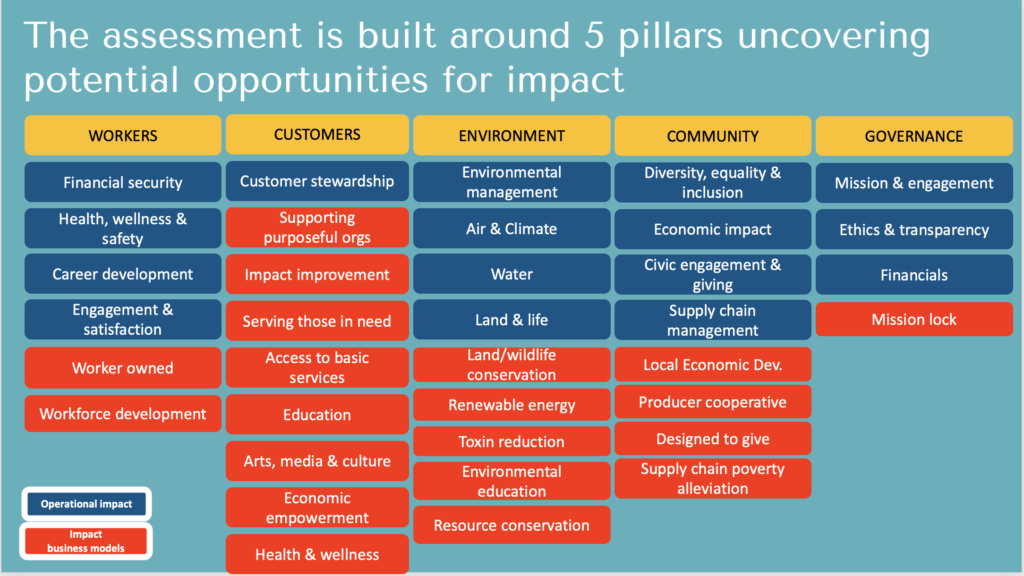
They separate the questions between operational, day to day type activities and Impact Business Models, which is where your business might solve a specific social or environmental challenge through (normally revenue-generating) products or services.
Making the most of being certified
Once you are certified, there are plenty of things you can to do to walk the B Corp walk.
1. Tell everyone!
2. Connect & collaborate with other BCorps in your sector
3. Target other B Corps as clients, so they align with your values
4. Publish annual impact report to show your social & environmental performance
5. Continuous improvements and re-certify every 3 years
If you would like to get started on your B Corp journey and would like the support of a trained B Leader, please get in contact at camilla@betterbusinessbetterworld.org